
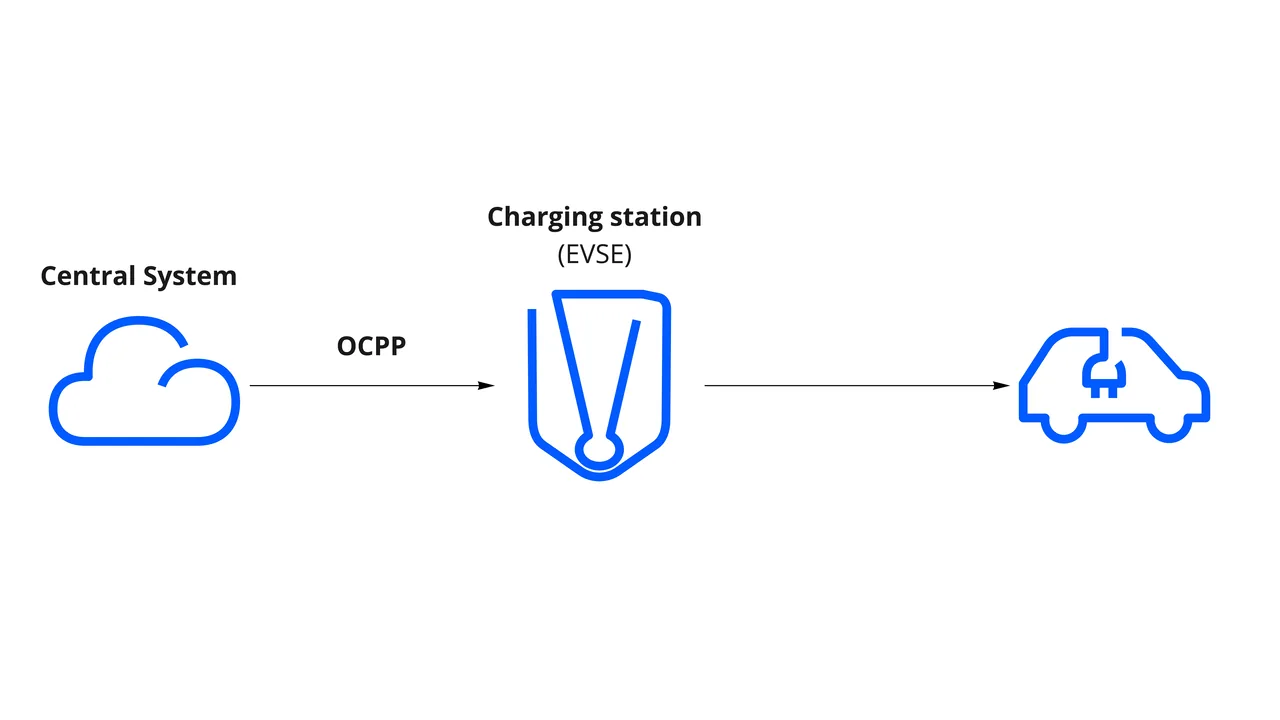
In a previous article, we saw how a silent home charger can start speaking OCPP, the common language of connected chargers (turning a silent home charger into a connected one). Once that channel is open, two very practical questions appear that the silent charger never had to ask: who is allowed to start a charge, and how do you start or stop a session on demand.
As long as the charger only serves one car, those questions do not exist: you plug in, you charge. The moment it becomes controllable, and potentially open to others, you need a way to decide who charges and a way to act on the session directly. Those are the two building blocks we detail here: access badges and manual control.
The badge: who is allowed to charge
At a public charger, you present a badge before charging. That badge carries a unique identifier, the idTag in OCPP terms. The charger, or the system supervising it, checks that this identifier is on an authorisation list, the so-called whitelist, before releasing current.
The important and often overlooked point: that list lives inside the charger itself. On chargers that support it, the whitelist is held in non-volatile memory, inside the hardware. It survives a power cut, a reboot, and above all the disappearance of a manufacturer cloud. A charger whose backend has shut down keeps authorising the badges it already knows.
Adding a badge takes a single gesture: the charger enters a waiting mode, you present the badge to the reader, and the charger records its identifier. This is enrolment by presentation, tap-to-enroll. No number to type by hand, the physically present badge is enough. Removal follows the reverse path: you point at the identifier to drop, and the charger erases it from its list.
Depending on the model, a badge can even carry a charging behaviour: one badge triggers an economical charge aligned with off-peak rates or solar production, another a full-power charge. Authorisation and charging policy then fit into the same gesture.
Manual control: start and stop on demand
The badge answers the question of authorisation. What remains is the question of action: how do you start a charge, or stop it, without waiting for a car and a badge to show up together?
That is the role of manual control. From an app or a supervisor, two commands are enough: start the session, stop the session. In OCPP terms, these are the RemoteStartTransaction and RemoteStopTransaction orders, literally "start" and "stop" the charging transaction. The charger receives the order, releases or cuts the current, then confirms.
This direct control unlocks several everyday situations:
- A guest shows up without a badge: you start their charge remotely, for the length of their visit, without enrolling anything.
- You want to fit charging into a specific window: you start at the beginning of the off-peak slot and stop at the end.
- A session gets stuck or the car will not stop on its own: a manual stop sets everything straight.
A safeguard rounds out the design: if the supervisor driving the charger disappears, say a network drop mid-session, the charger does not stay open forever. After a configurable grace period, it cleanly stops the ongoing charge. Manual control is never a blank cheque handed to a system that may have crashed.
Two blocks that answer each other
Taken separately, these two blocks are useful. Together, they turn a charger into genuinely manageable equipment. The badge answers who, manual control answers when and how. And since every session starts with a known identifier, the charger can attribute each delivered kilowatt-hour to a specific badge.
That traceability is the key to fair billing. As long as the charger charges anonymously, there is no telling who consumed what. Once each session is tied to a badge or an identified trigger, consumption splits cleanly: this much for you, that much for a tenant, that much for a neighbour. The charger stops being a mere socket and becomes a metered service point.
From control to sharing
Once you decide who charges and you drive the sessions, a possibility opens up naturally: opening your charger to other drivers, during the long stretches when none of your own cars is plugged in.
That is exactly what PotatoCharge orchestrates. Rather than handing physical badges to every neighbour, each session that goes through the platform is authenticated end to end, by the app or a one-shot code, and traced for billing. The passing driver starts their charge, the charger meters what it delivers, you collect the matching revenue. The authorisation and manual control we just described are the technical foundation this sharing rests on.
Open your charger as a private host or put a business charger at the service of the public.
Frequently asked questions
What is an access badge, or idTag, on a charger?
It is a unique identifier carried by an RFID badge. Before releasing current, the charger checks that this identifier is on its authorisation list. The badge answers the question: who is allowed to charge?
Does the list of authorised badges depend on a cloud?
No, on chargers that manage their whitelist locally. The list is stored inside the charger, in non-volatile memory. It survives outages and the shutdown of a manufacturer backend: the charger keeps authorising the badges it already knows.
Can you start a charge without a badge?
Yes, through manual control. From an app or a supervisor, the remote start and stop commands (RemoteStartTransaction and RemoteStopTransaction in OCPP) start or cut a session without presenting a badge.
What happens if the supervisor goes down during a charge?
A configurable grace period protects the charger: once that delay passes with no news from the supervisor, it cleanly stops the ongoing session rather than staying open indefinitely.
