The vast majority of home chargers installed in Belgium and France talk to nobody. They charge, and that is it. No metering pushed out, no remote control from an app, no dynamic authorisation based on the badge presented or the time of day. For Nexxtender chargers, the shutdown of the Powerdale backend even cut off what little communication did exist before.
Why silence is a problem
As long as a charger merely tops up its owner's car, silence is comfortable. The need appears as soon as a more refined use enters the picture: lining charging sessions up with off-peak rates, tracking consumption per session to bill a tenant or a neighbour, booking time slots remotely, integrating the charger with a solar inverter that needs to know how much current to request. Without a communication channel, none of this is feasible.
The situation is paradoxical: the charger already holds every piece of information needed to answer those questions. At every second, it knows how much current it delivers, at what voltage, for how long. It knows how to start or stop a session. Those signals are accessible locally over Bluetooth, but through a proprietary protocol that neither energy supervisors nor consumer apps understand.
OCPP, the language of connected chargers
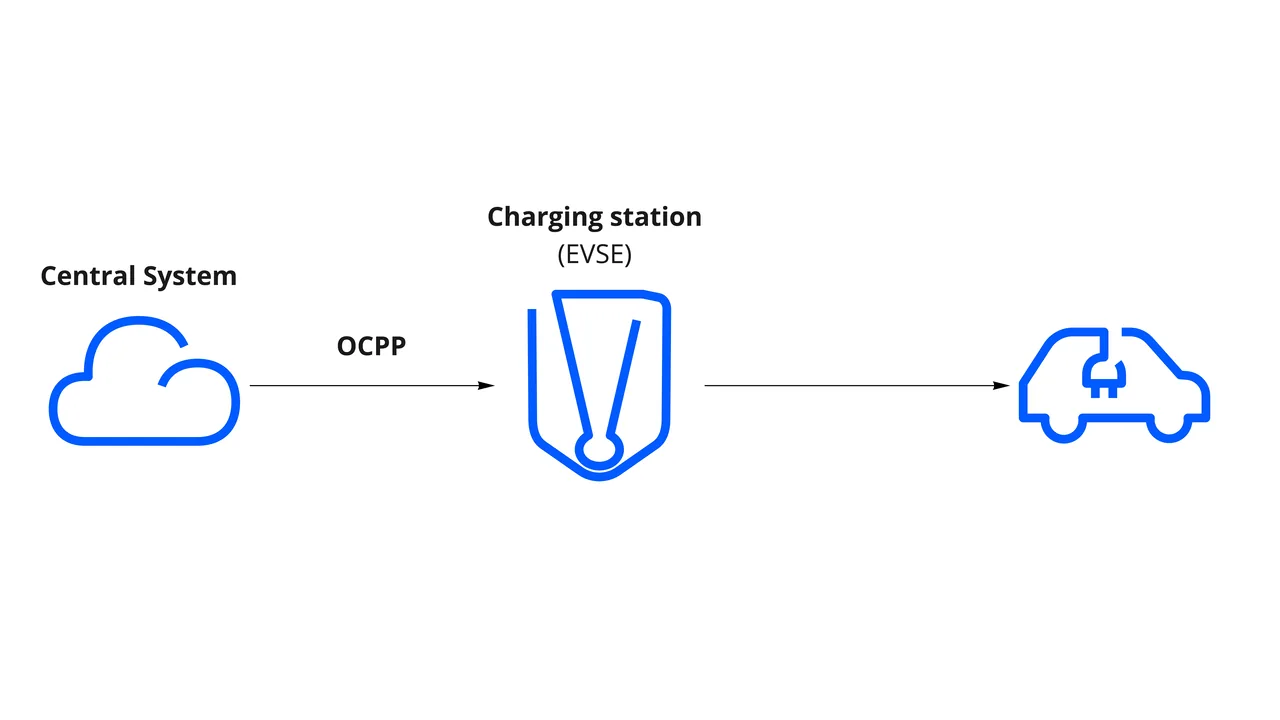
Public chargers, the ones in motorway stations or corporate car parks, all speak the same language: OCPP, for Open Charge Point Protocol. It is this protocol that lets an operator supervise thousands of chargers remotely, start a session on badge presentation, or bill against the kilowatt-hours actually delivered.
On the residential side, OCPP is also the standard accepted by every serious energy supervisor: solar self-consumption software, home automation systems, fleet management apps. A charger that speaks OCPP becomes readable and controllable by any of them, with no dependency on a manufacturer's application.
The bridge we operate
To bring Nexxtender chargers onto that standard, we built a bridge. The principle is simple: a small service runs inside the owner's home, on a dedicated box or on a mini server already there. On one side, it maintains a permanent Bluetooth link with the charger and translates its proprietary signals. On the other, it exposes that information as a standard OCPP endpoint that any supervisor can connect to.
Everything happens locally. The plugged-in car sends its requests to the service, the service relays them to the charger, the charger delivers power, the service reports the metering back to the supervisor. No manufacturer cloud is involved, and no data leaves your network unless you choose to send it.
What this unlocks in practice
Once the bridge is in place, a Nexxtender (and more broadly any charger whose protocol we know how to translate) becomes:
- Remotely controllable, from an app or supervisor, without ever having to physically touch the charger again.
- Precisely metered, with energy and power readings per session that can be used for billing or for your own tracking.
- Integrated into your energy stack: alignment with off-peak slots, modulation against solar production, automatic cutoff when a higher-priority load kicks in elsewhere in the house.
- Open to third parties with proper authentication (badge or one-shot code), making the charger usable by a neighbour, a tenant or a passing driver, under a clear audit trail.
Why we built the bridge ourselves
This bridge exists because PotatoCharge needed it. Our business is matching hosts (the owners of chargers) with drivers (the people who need to charge). For that to work, the chargers opened to the public must be able to start a session on demand, meter what they deliver, and end the session cleanly. In other words, they need to speak OCPP.
We first checked whether the work had already been done. For part of the installed base, it had. For Nexxtender chargers, it had not. And given the manufacturer's disappearance, nobody else was going to take it on. Rather than excluding those chargers from our service, we chose to write the bridge ourselves. It now benefits owners who join PotatoCharge as much as those who simply want their local control back.
The next question
Your charger now knows how to speak. The natural question that follows is: to whom? If it stays dedicated to your own car, you regain fine-grained control and energy integration, which alone is worth the effort. But a connected charger can do more: accept a neighbour's car a few hours per week, and generate steady income that offsets your initial investment.
That is exactly what PotatoCharge offers: one charger, one app, a neighbour who pays for their session, and you who collect the matching revenue at the end of the month.
Become a private host on PotatoCharge or open a business charger to the public.